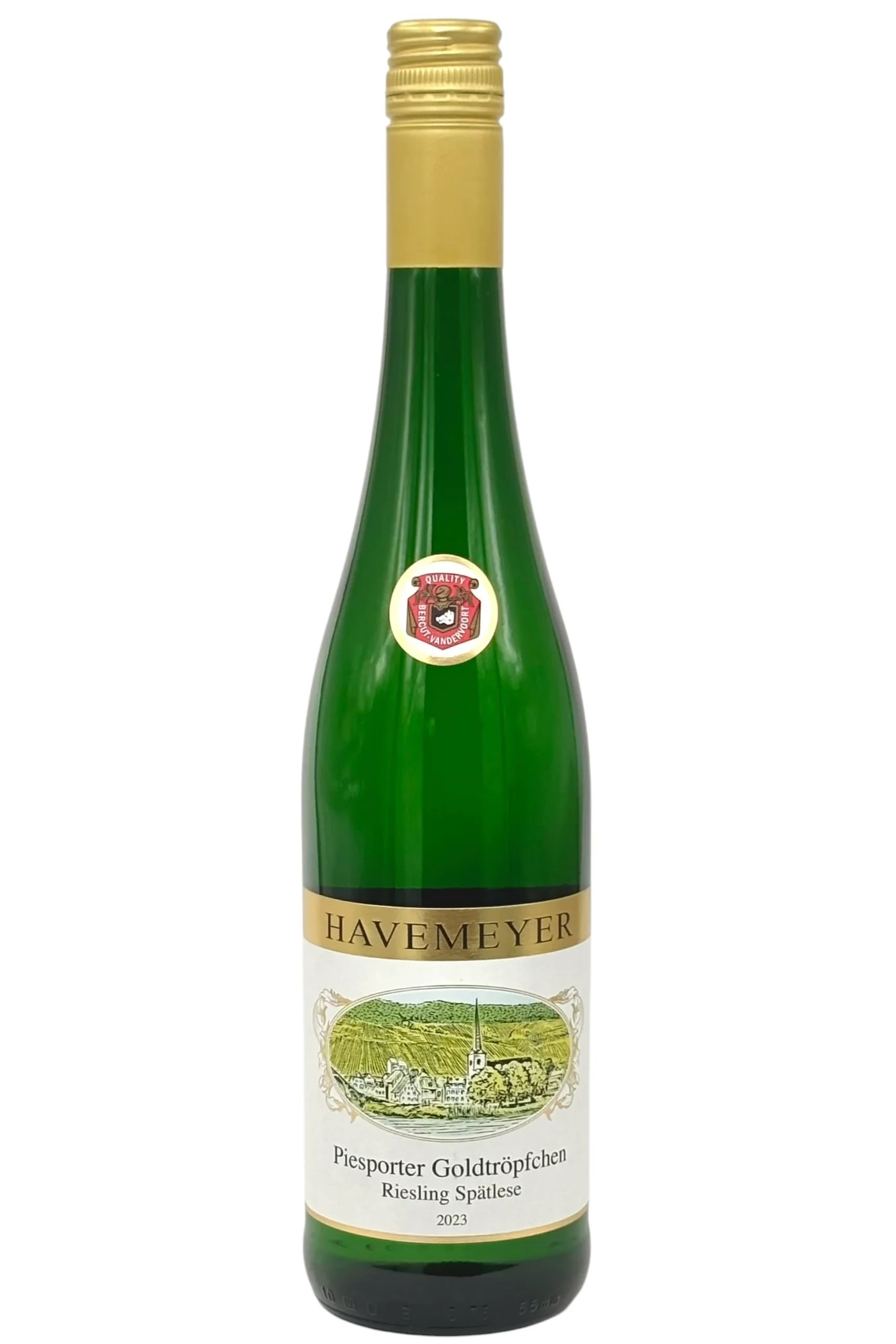
Havemeyer 2023 Riesling Spatlese Piesporter Goldtropfchen
Piesporter Goldtröpfchen is one of the most celebrated vineyard sites in the Mosel Valley — and one of the most historically significant addresses in all of German wine. The name translates to "little golden drops" — a reference to the golden light that falls on the steep, south-facing slate slopes overlooking the Mosel River and the extraordinary concentrated sweetness that those sun-drenched, late-ripening grapes produce when picked at Spätlese timing. This is not simply a vineyard with a poetic name; it is a site with centuries of documented quality, favored by connoisseurs and royalty alike, whose Devonian blue slate soils produce Riesling of a mineral depth and aromatic complexity that flat-land vineyards cannot approach regardless of technique.
Havemeyer's 2023 Spätlese is the most direct and accessible expression of what Goldtröpfchen Riesling is — and what makes German Spätlese one of the wine world's great undervalued pleasures. At approximately 8.5% ABV and approximately 61 grams per liter of residual sugar, it occupies the precise sweet spot of the German Prädikat hierarchy: enough sweetness to fill the mouth with ripe fruit richness and weight, enough natural acidity to keep every sip bright, focused, and appetizing rather than cloying. The combination is uniquely Mosel — no other wine region in the world achieves it with the same elegance or aromatic intensity.
The 2023 growing season on the Mosel was excellent — warm, dry conditions with well-timed rainfall produced fruit of exceptional ripeness and concentration, with natural acidity preserved by the region's cool nights. For Goldtröpfchen Spätlese, those are ideal conditions: maximum aromatic expression from the sun-facing slate, maximum freshness from the Mosel's cool riverside air.
Origins & Craftsmanship
The Mosel Valley is Germany's most dramatic and most storied wine region — a river that winds through steep slate gorges from Trier to the Rhine, its south-facing slopes trapping heat and reflecting it from the water's surface onto the vines above, producing conditions that allow Riesling to ripen at latitudes that would otherwise be impossible. The Mosel's Devonian blue slate soils — ancient metamorphic rock that absorbs heat during the day and releases it at night — are the geological foundation of the region's greatest wines, imparting the distinctive mineral quality that separates Mosel Riesling from all other German wine regions.
Piesporter Goldtröpfchen is the most celebrated single vineyard in Piesport — a horseshoe-shaped amphitheater of steep south-facing Devonian slate slopes that is widely considered among the Mosel's finest sites. Its exposition, angle, and slate composition create a natural solar furnace that allows Riesling grapes to achieve exceptional ripeness while the surrounding cool valley air and the river's proximity preserve the natural acidity that is the variety's defining quality. The steep gradient — up to 70 degrees in the steepest sections — requires all viticultural work to be done by hand, including harvest, which is conducted in multiple passes through the vineyard to select only grapes at the precise ripeness level required for each Prädikat classification.
Havemeyer's Spätlese is sourced from Goldtröpfchen's classic Devonian slate parcels and vinified in the traditional Mosel style: fermentation at low temperatures to preserve the grape's natural aromatics, with fermentation arrested before full dryness to preserve the natural residual sugar at the approximately 61 g/L Spätlese level — not added sweetness but the grape's own natural ripeness left unconverted in the wine. The result is bottled at approximately 8.5% ABV — the hallmark of authentic Mosel Spätlese, where the balance of unfermented grape sugar and natural tartaric acid creates the tension that makes this style uniquely refreshing despite its sweetness.
Critics Reviews
Wine-Searcher aggregates an 84-point score across Havemeyer Piesporter Goldtröpfchen Spätlese vintages. There are no widely published scores from Wine Spectator, Wine Advocate, or Vinous available for the 2023 vintage specifically at this time.
The Piesporter Goldtröpfchen vineyard's quality is well-established across the broader Mosel wine world: Dr. Loosen's Spätlese expressions from neighboring Mosel sites regularly earn 92–94 points from James Suckling and Wine Spectator, confirming the appellation's standing at the top tier of German Riesling production.
Tasting Profile
Nose Pale gold with gentle green reflections — the hallmark color of cool-climate Mosel Riesling at its freshest. The nose is immediately expressive and classically Goldtröpfchen: candied pear and ripe apple lead with delicate sweetness, followed by fresh peach and apricot that add stone fruit depth. White blossom and a gentle floral lift from the slate soils thread through the fruit aromatics, alongside a characteristic wet slate and mineral note that is the Devonian terroir's most direct aromatic signature. Tropical melon and a whisper of tangerine add exotic citrus dimension, while the classic aged Riesling petrol note is present in its youngest, most nascent form — more of an intriguing whisper than the dominant characteristic it becomes with age. The overall impression is aromatic, precise, and entirely fresh.
Palate The Spätlese's defining quality is most apparent on the palate: the sweetness and acidity arrive together and in complete equilibrium, each amplifying rather than competing with the other. Ripe peach, candied pear, and apple arrive first with lush, generous fruit sweetness — fully ripened, concentrated, and expressive of Goldtröpfchen's remarkable south-facing sun exposure. The acidity follows immediately — bright, mouthwatering, and persistent — cutting through the sweetness and leaving the palate refreshed rather than coated. Slate mineral and a light stony quality thread through the fruit at the center, adding the terroir dimension that distinguishes Goldtröpfchen from flatter Mosel sites. Tropical melon and citrus add further fruit brightness as the palate develops. The mouthfeel is light to medium-bodied — the 8.5% ABV keeping the wine delicate and refreshing rather than heavy or vinous.
Finish Clean, bright, and persistently mineral. Fresh acidity and ripe stone fruit lead the close before the Goldtröpfchen slate's mineral character takes over — cool, slightly stony, and deeply refreshing. A final whisper of white blossom and citrus zest fades gradually and cleanly. The finish is medium in length and mouthwatering throughout — the perfect invitation to the next sip or the next bite of food.
Quick Overview
| Category | Details |
|---|---|
| Appellation | Mosel — Piesporter Goldtröpfchen |
| Classification | Spätlese (QmP — Qualitätswein mit Prädikat) |
| Vintage | 2023 |
| Producer | Havemeyer |
| Varietal | 100% Riesling |
| ABV | Approximately 8.5% ABV |
| Residual Sugar | Approximately 61 g/L |
| Vineyard | Piesporter Goldtröpfchen — steep south-facing Devonian blue slate |
| Harvest | Late harvest — multiple passes, hand-selected |
| Vinification | Low-temperature fermentation — natural residual sugar |
| Style / Identity | Classic Mosel Spätlese — off-dry, fruit-forward, slate-mineral, bright acidity |
| Aromas & Flavors | Candied pear, ripe apple, peach, apricot, white blossom, wet slate, tropical melon, tangerine, nascent petrol |
| Drink Window | Now through 2030+ — develops petrol complexity with age |
| Bottle Size | 750ml |
Serving & Occasion
Best served well chilled at 8–10°C — the cooler the temperature, the sharper and more focused the slate minerality and citrus acidity become. No decanting required. The Spätlese's combination of gentle sweetness and bright acidity makes it one of the most food-versatile wines available: classic pairings include spicy Asian cuisine (Thai, Vietnamese, Sichuan), Indian curries, smoked salmon, blue cheese, fresh fruit desserts, crab, lobster, and any dish with a sweet-savory balance. The residual sweetness also makes it an outstanding standalone aperitif or a lighter dessert wine alongside fruit tarts, peach-based pastries, or crème brûlée. Outstanding value for the Goldtröpfchen terroir it represents — a wine that improves considerably with 3–5 years of cellaring as the petrol character develops and the fruit deepens.
Original: $20.00
-65%$20.00
$7.00Havemeyer 2023 Riesling Spatlese Piesporter Goldtropfchen
Piesporter Goldtröpfchen is one of the most celebrated vineyard sites in the Mosel Valley — and one of the most historically significant addresses in all of German wine. The name translates to "little golden drops" — a reference to the golden light that falls on the steep, south-facing slate slopes overlooking the Mosel River and the extraordinary concentrated sweetness that those sun-drenched, late-ripening grapes produce when picked at Spätlese timing. This is not simply a vineyard with a poetic name; it is a site with centuries of documented quality, favored by connoisseurs and royalty alike, whose Devonian blue slate soils produce Riesling of a mineral depth and aromatic complexity that flat-land vineyards cannot approach regardless of technique.
Havemeyer's 2023 Spätlese is the most direct and accessible expression of what Goldtröpfchen Riesling is — and what makes German Spätlese one of the wine world's great undervalued pleasures. At approximately 8.5% ABV and approximately 61 grams per liter of residual sugar, it occupies the precise sweet spot of the German Prädikat hierarchy: enough sweetness to fill the mouth with ripe fruit richness and weight, enough natural acidity to keep every sip bright, focused, and appetizing rather than cloying. The combination is uniquely Mosel — no other wine region in the world achieves it with the same elegance or aromatic intensity.
The 2023 growing season on the Mosel was excellent — warm, dry conditions with well-timed rainfall produced fruit of exceptional ripeness and concentration, with natural acidity preserved by the region's cool nights. For Goldtröpfchen Spätlese, those are ideal conditions: maximum aromatic expression from the sun-facing slate, maximum freshness from the Mosel's cool riverside air.
Origins & Craftsmanship
The Mosel Valley is Germany's most dramatic and most storied wine region — a river that winds through steep slate gorges from Trier to the Rhine, its south-facing slopes trapping heat and reflecting it from the water's surface onto the vines above, producing conditions that allow Riesling to ripen at latitudes that would otherwise be impossible. The Mosel's Devonian blue slate soils — ancient metamorphic rock that absorbs heat during the day and releases it at night — are the geological foundation of the region's greatest wines, imparting the distinctive mineral quality that separates Mosel Riesling from all other German wine regions.
Piesporter Goldtröpfchen is the most celebrated single vineyard in Piesport — a horseshoe-shaped amphitheater of steep south-facing Devonian slate slopes that is widely considered among the Mosel's finest sites. Its exposition, angle, and slate composition create a natural solar furnace that allows Riesling grapes to achieve exceptional ripeness while the surrounding cool valley air and the river's proximity preserve the natural acidity that is the variety's defining quality. The steep gradient — up to 70 degrees in the steepest sections — requires all viticultural work to be done by hand, including harvest, which is conducted in multiple passes through the vineyard to select only grapes at the precise ripeness level required for each Prädikat classification.
Havemeyer's Spätlese is sourced from Goldtröpfchen's classic Devonian slate parcels and vinified in the traditional Mosel style: fermentation at low temperatures to preserve the grape's natural aromatics, with fermentation arrested before full dryness to preserve the natural residual sugar at the approximately 61 g/L Spätlese level — not added sweetness but the grape's own natural ripeness left unconverted in the wine. The result is bottled at approximately 8.5% ABV — the hallmark of authentic Mosel Spätlese, where the balance of unfermented grape sugar and natural tartaric acid creates the tension that makes this style uniquely refreshing despite its sweetness.
Critics Reviews
Wine-Searcher aggregates an 84-point score across Havemeyer Piesporter Goldtröpfchen Spätlese vintages. There are no widely published scores from Wine Spectator, Wine Advocate, or Vinous available for the 2023 vintage specifically at this time.
The Piesporter Goldtröpfchen vineyard's quality is well-established across the broader Mosel wine world: Dr. Loosen's Spätlese expressions from neighboring Mosel sites regularly earn 92–94 points from James Suckling and Wine Spectator, confirming the appellation's standing at the top tier of German Riesling production.
Tasting Profile
Nose Pale gold with gentle green reflections — the hallmark color of cool-climate Mosel Riesling at its freshest. The nose is immediately expressive and classically Goldtröpfchen: candied pear and ripe apple lead with delicate sweetness, followed by fresh peach and apricot that add stone fruit depth. White blossom and a gentle floral lift from the slate soils thread through the fruit aromatics, alongside a characteristic wet slate and mineral note that is the Devonian terroir's most direct aromatic signature. Tropical melon and a whisper of tangerine add exotic citrus dimension, while the classic aged Riesling petrol note is present in its youngest, most nascent form — more of an intriguing whisper than the dominant characteristic it becomes with age. The overall impression is aromatic, precise, and entirely fresh.
Palate The Spätlese's defining quality is most apparent on the palate: the sweetness and acidity arrive together and in complete equilibrium, each amplifying rather than competing with the other. Ripe peach, candied pear, and apple arrive first with lush, generous fruit sweetness — fully ripened, concentrated, and expressive of Goldtröpfchen's remarkable south-facing sun exposure. The acidity follows immediately — bright, mouthwatering, and persistent — cutting through the sweetness and leaving the palate refreshed rather than coated. Slate mineral and a light stony quality thread through the fruit at the center, adding the terroir dimension that distinguishes Goldtröpfchen from flatter Mosel sites. Tropical melon and citrus add further fruit brightness as the palate develops. The mouthfeel is light to medium-bodied — the 8.5% ABV keeping the wine delicate and refreshing rather than heavy or vinous.
Finish Clean, bright, and persistently mineral. Fresh acidity and ripe stone fruit lead the close before the Goldtröpfchen slate's mineral character takes over — cool, slightly stony, and deeply refreshing. A final whisper of white blossom and citrus zest fades gradually and cleanly. The finish is medium in length and mouthwatering throughout — the perfect invitation to the next sip or the next bite of food.
Quick Overview
| Category | Details |
|---|---|
| Appellation | Mosel — Piesporter Goldtröpfchen |
| Classification | Spätlese (QmP — Qualitätswein mit Prädikat) |
| Vintage | 2023 |
| Producer | Havemeyer |
| Varietal | 100% Riesling |
| ABV | Approximately 8.5% ABV |
| Residual Sugar | Approximately 61 g/L |
| Vineyard | Piesporter Goldtröpfchen — steep south-facing Devonian blue slate |
| Harvest | Late harvest — multiple passes, hand-selected |
| Vinification | Low-temperature fermentation — natural residual sugar |
| Style / Identity | Classic Mosel Spätlese — off-dry, fruit-forward, slate-mineral, bright acidity |
| Aromas & Flavors | Candied pear, ripe apple, peach, apricot, white blossom, wet slate, tropical melon, tangerine, nascent petrol |
| Drink Window | Now through 2030+ — develops petrol complexity with age |
| Bottle Size | 750ml |
Serving & Occasion
Best served well chilled at 8–10°C — the cooler the temperature, the sharper and more focused the slate minerality and citrus acidity become. No decanting required. The Spätlese's combination of gentle sweetness and bright acidity makes it one of the most food-versatile wines available: classic pairings include spicy Asian cuisine (Thai, Vietnamese, Sichuan), Indian curries, smoked salmon, blue cheese, fresh fruit desserts, crab, lobster, and any dish with a sweet-savory balance. The residual sweetness also makes it an outstanding standalone aperitif or a lighter dessert wine alongside fruit tarts, peach-based pastries, or crème brûlée. Outstanding value for the Goldtröpfchen terroir it represents — a wine that improves considerably with 3–5 years of cellaring as the petrol character develops and the fruit deepens.
Product Information
Product Information
Shipping & Returns
Shipping & Returns
Description
Piesporter Goldtröpfchen is one of the most celebrated vineyard sites in the Mosel Valley — and one of the most historically significant addresses in all of German wine. The name translates to "little golden drops" — a reference to the golden light that falls on the steep, south-facing slate slopes overlooking the Mosel River and the extraordinary concentrated sweetness that those sun-drenched, late-ripening grapes produce when picked at Spätlese timing. This is not simply a vineyard with a poetic name; it is a site with centuries of documented quality, favored by connoisseurs and royalty alike, whose Devonian blue slate soils produce Riesling of a mineral depth and aromatic complexity that flat-land vineyards cannot approach regardless of technique.
Havemeyer's 2023 Spätlese is the most direct and accessible expression of what Goldtröpfchen Riesling is — and what makes German Spätlese one of the wine world's great undervalued pleasures. At approximately 8.5% ABV and approximately 61 grams per liter of residual sugar, it occupies the precise sweet spot of the German Prädikat hierarchy: enough sweetness to fill the mouth with ripe fruit richness and weight, enough natural acidity to keep every sip bright, focused, and appetizing rather than cloying. The combination is uniquely Mosel — no other wine region in the world achieves it with the same elegance or aromatic intensity.
The 2023 growing season on the Mosel was excellent — warm, dry conditions with well-timed rainfall produced fruit of exceptional ripeness and concentration, with natural acidity preserved by the region's cool nights. For Goldtröpfchen Spätlese, those are ideal conditions: maximum aromatic expression from the sun-facing slate, maximum freshness from the Mosel's cool riverside air.
Origins & Craftsmanship
The Mosel Valley is Germany's most dramatic and most storied wine region — a river that winds through steep slate gorges from Trier to the Rhine, its south-facing slopes trapping heat and reflecting it from the water's surface onto the vines above, producing conditions that allow Riesling to ripen at latitudes that would otherwise be impossible. The Mosel's Devonian blue slate soils — ancient metamorphic rock that absorbs heat during the day and releases it at night — are the geological foundation of the region's greatest wines, imparting the distinctive mineral quality that separates Mosel Riesling from all other German wine regions.
Piesporter Goldtröpfchen is the most celebrated single vineyard in Piesport — a horseshoe-shaped amphitheater of steep south-facing Devonian slate slopes that is widely considered among the Mosel's finest sites. Its exposition, angle, and slate composition create a natural solar furnace that allows Riesling grapes to achieve exceptional ripeness while the surrounding cool valley air and the river's proximity preserve the natural acidity that is the variety's defining quality. The steep gradient — up to 70 degrees in the steepest sections — requires all viticultural work to be done by hand, including harvest, which is conducted in multiple passes through the vineyard to select only grapes at the precise ripeness level required for each Prädikat classification.
Havemeyer's Spätlese is sourced from Goldtröpfchen's classic Devonian slate parcels and vinified in the traditional Mosel style: fermentation at low temperatures to preserve the grape's natural aromatics, with fermentation arrested before full dryness to preserve the natural residual sugar at the approximately 61 g/L Spätlese level — not added sweetness but the grape's own natural ripeness left unconverted in the wine. The result is bottled at approximately 8.5% ABV — the hallmark of authentic Mosel Spätlese, where the balance of unfermented grape sugar and natural tartaric acid creates the tension that makes this style uniquely refreshing despite its sweetness.
Critics Reviews
Wine-Searcher aggregates an 84-point score across Havemeyer Piesporter Goldtröpfchen Spätlese vintages. There are no widely published scores from Wine Spectator, Wine Advocate, or Vinous available for the 2023 vintage specifically at this time.
The Piesporter Goldtröpfchen vineyard's quality is well-established across the broader Mosel wine world: Dr. Loosen's Spätlese expressions from neighboring Mosel sites regularly earn 92–94 points from James Suckling and Wine Spectator, confirming the appellation's standing at the top tier of German Riesling production.
Tasting Profile
Nose Pale gold with gentle green reflections — the hallmark color of cool-climate Mosel Riesling at its freshest. The nose is immediately expressive and classically Goldtröpfchen: candied pear and ripe apple lead with delicate sweetness, followed by fresh peach and apricot that add stone fruit depth. White blossom and a gentle floral lift from the slate soils thread through the fruit aromatics, alongside a characteristic wet slate and mineral note that is the Devonian terroir's most direct aromatic signature. Tropical melon and a whisper of tangerine add exotic citrus dimension, while the classic aged Riesling petrol note is present in its youngest, most nascent form — more of an intriguing whisper than the dominant characteristic it becomes with age. The overall impression is aromatic, precise, and entirely fresh.
Palate The Spätlese's defining quality is most apparent on the palate: the sweetness and acidity arrive together and in complete equilibrium, each amplifying rather than competing with the other. Ripe peach, candied pear, and apple arrive first with lush, generous fruit sweetness — fully ripened, concentrated, and expressive of Goldtröpfchen's remarkable south-facing sun exposure. The acidity follows immediately — bright, mouthwatering, and persistent — cutting through the sweetness and leaving the palate refreshed rather than coated. Slate mineral and a light stony quality thread through the fruit at the center, adding the terroir dimension that distinguishes Goldtröpfchen from flatter Mosel sites. Tropical melon and citrus add further fruit brightness as the palate develops. The mouthfeel is light to medium-bodied — the 8.5% ABV keeping the wine delicate and refreshing rather than heavy or vinous.
Finish Clean, bright, and persistently mineral. Fresh acidity and ripe stone fruit lead the close before the Goldtröpfchen slate's mineral character takes over — cool, slightly stony, and deeply refreshing. A final whisper of white blossom and citrus zest fades gradually and cleanly. The finish is medium in length and mouthwatering throughout — the perfect invitation to the next sip or the next bite of food.
Quick Overview
| Category | Details |
|---|---|
| Appellation | Mosel — Piesporter Goldtröpfchen |
| Classification | Spätlese (QmP — Qualitätswein mit Prädikat) |
| Vintage | 2023 |
| Producer | Havemeyer |
| Varietal | 100% Riesling |
| ABV | Approximately 8.5% ABV |
| Residual Sugar | Approximately 61 g/L |
| Vineyard | Piesporter Goldtröpfchen — steep south-facing Devonian blue slate |
| Harvest | Late harvest — multiple passes, hand-selected |
| Vinification | Low-temperature fermentation — natural residual sugar |
| Style / Identity | Classic Mosel Spätlese — off-dry, fruit-forward, slate-mineral, bright acidity |
| Aromas & Flavors | Candied pear, ripe apple, peach, apricot, white blossom, wet slate, tropical melon, tangerine, nascent petrol |
| Drink Window | Now through 2030+ — develops petrol complexity with age |
| Bottle Size | 750ml |
Serving & Occasion
Best served well chilled at 8–10°C — the cooler the temperature, the sharper and more focused the slate minerality and citrus acidity become. No decanting required. The Spätlese's combination of gentle sweetness and bright acidity makes it one of the most food-versatile wines available: classic pairings include spicy Asian cuisine (Thai, Vietnamese, Sichuan), Indian curries, smoked salmon, blue cheese, fresh fruit desserts, crab, lobster, and any dish with a sweet-savory balance. The residual sweetness also makes it an outstanding standalone aperitif or a lighter dessert wine alongside fruit tarts, peach-based pastries, or crème brûlée. Outstanding value for the Goldtröpfchen terroir it represents — a wine that improves considerably with 3–5 years of cellaring as the petrol character develops and the fruit deepens.