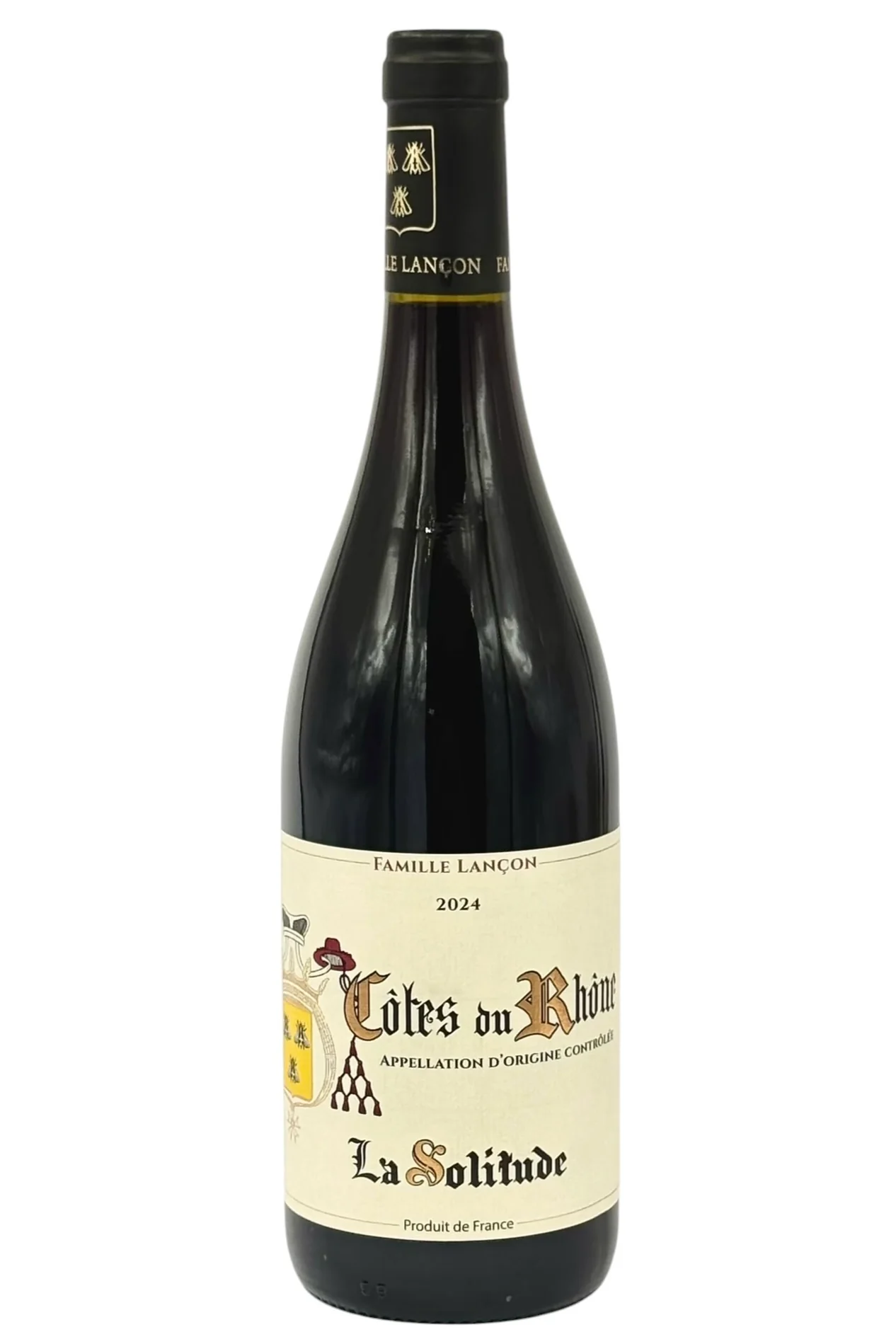
Famille Lançon "La Solitude" 2024 Côtes-du-Rhône Rouge Biodynamic Organic Red Blend 750ml
The Lançon family has been making wine on the western edge of Châteauneuf-du-Pape since the 17th century — a heritage that traces directly to the 12th-century Barberini family of Rome, whose most celebrated member became Pope Urban VIII. That papal lineage graces the label. The winemaking that fills the bottle, however, belongs entirely to the present: eighth-generation winemaker Florent Lançon, who took over the estate in 2008, has transformed Domaine de la Solitude into one of the Southern Rhône's most progressive properties — certified organic since 2020, certified biodynamic since 2023, and an internationally recognized exemplar of what regenerative viticulture looks like in practice.
The Côtes-du-Rhône Rouge is the estate's most accessible entry point, and it punches well above its appellation. Sourced from clay and limestone gravel soils in the broader southern Rhône, the wine is a classic GSM blend — Grenache, Syrah, and Mourvèdre — vinified in concrete vats with a careful maceration period that extracts color and structure without harshness, then aged on lees to build texture and depth. The result is a wine of genuine character: dark berry fruit, garrigue, warm spice, and the unmistakable perfume of the southern French scrubland that defines the appellation's aromatic identity.
Wine Spectator and Wine Advocate have consistently recognized the broader La Solitude range at 88–90 points across multiple vintages. For the price, this is the Southern Rhône overdelivering in exactly the way it does best.
Origins & Craftsmanship
The estate's origins date to 1264, when the first members of the Lançon family arrived from Italy to serve the papacy in Avignon — a service that eventually produced Pope Urban VIII, the Barberini coat of arms that still adorns the label, and a continuous winemaking tradition spanning eight generations on the same Châteauneuf-du-Pape land. The La Solitude lieu-dit sits on the western edge of the celebrated La Crau plateau, within the boundaries of Châteauneuf-du-Pape's most storied terroir.
The Côtes-du-Rhône vineyard parcels draw from the broader appellation footprint — iron-rich topsoil over clay and limestone gravel, typical of the southern Rhône's Mediterranean terroir — exposed to the drying, vine-healthening force of the Mistral wind, which circulates air through the canopy and reduces disease pressure naturally. Florent Lançon farms the entire estate biodynamically: no synthetic chemistry, cover crops between rows, polyculture including ancient olive trees, citrus varieties, persimmon, apricot-plum, juniper, and Sichuan pepper trees integrated into what he calls an "edible vineyard" — four hectares of biodiversity that creates natural microclimates, builds soil vitality, and supports the beneficial wildlife the vines require for balance.
In the cellar, the approach is equally intentional. The Côtes-du-Rhône Rouge blend of approximately 45% Grenache noir, 45% Syrah, and 10% Mourvèdre is sorted and destemmed by hand, vinified in concrete vats — which preserve freshness and fruit clarity without imparting oak flavors — with macerations of approximately 25 days for gentle, progressive extraction. Each grape variety and parcel is vinified separately to preserve individual character before final blending. The wine is aged on fine lees before bottling, adding texture and aromatic complexity without weight.
Critics Reviews
Wine Spectator and Wine Advocate have awarded the La Solitude Côtes-du-Rhône Rouge 88 points across multiple recent vintages, consistently recognizing its quality-to-value ratio and the estate's elevated production standards. Jeb Dunnuck of Wine Advocate has praised Florent Lançon as "young, yet incredibly talented," noting the estate's position at the heart of the Châteauneuf-du-Pape appellation. The La Solitude range across all cuvées has received scores of 90–92 points from James Suckling and Wine Advocate for the Châteauneuf-du-Pape expressions, underscoring the estate's overall quality ceiling.
No numeric scores specific to the 2024 vintage of the Côtes-du-Rhône Rouge are yet widely published.
Tasting Profile
Nose Inviting and deeply aromatic — the Southern Rhône garigue comes forward immediately. Dark cherries and bramble lead, followed by raspberry liqueur and a spiced herb character of rosemary, lavender, and dried thyme. The Mourvèdre's contribution shows in a faint but appealing note of iron-rich earth and dark violet beneath the fruit. With a few minutes of air, anise, warm baking spice, and a whisper of garrigue scrubland deepen the whole.
Palate Round, supple, and generously fruited — exactly the medium-bodied, food-friendly character that makes southern Rhône rouge indispensable at the table. Spicy dark berries and morello cherry dominate the entry, with Grenache's natural warmth and Syrah's peppery backbone weaving through the mid-palate. Fine-grained tannins from the concrete-vat maceration provide structure without grip. A subtle earthiness and lavender note from the biodynamic farming expresses through the fruit — the kind of terroir character that certified organic and biodynamic wines consistently deliver over conventional equivalents.
Finish Medium in length, clean, and pleasantly spiced. Dark fruit and warm herbs fade together, with a final note of cinnamon and garrigue that lingers gently. Fresh, dry, and deeply satisfying — built for the next sip as much as the last.
Quick Overview
| Category | Details |
|---|---|
| Appellation | Côtes-du-Rhône Rouge AOC |
| Vintage | 2024 |
| Origin / Region | Southern Rhône Valley, France |
| Producer | Domaine de la Solitude — Florent Lançon, 8th generation |
| Blend | ~45% Grenache Noir · ~45% Syrah · ~10% Mourvèdre |
| Terroir | Iron-rich topsoil over clay and limestone gravel |
| Farming | Certified Biodynamic (2023) · Certified Organic (2020) |
| Harvest | Manual — hand-sorted |
| Vinification | Concrete vats · ~25-day maceration · parcel-by-parcel vinification |
| Aging | On fine lees before bottling |
| Style / Identity | Southern Rhône rouge — fruit-forward, garrigue-scented, supple, biodynamic |
| Aromas & Flavors | Dark cherry, bramble, raspberry, garrigue, rosemary, lavender, thyme, anise, warm spice |
| Critics | Wine Spectator / Wine Advocate — 88 Points (recent vintages) |
| Bottle Size | 750ml |
Serving & Occasion
Best served slightly cool — 16–17°C — in a generous Burgundy-style glass that allows the garrigue aromatics to open fully. Decanting 20–30 minutes will round the tannins and deepen the fruit. A quintessential food wine: exceptional alongside Provençal lamb, ratatouille, roasted duck, herbed pork, charcuterie boards, aged sheep's milk cheeses, and anything featuring rosemary, thyme, or lavender in the preparation. Equally at home as a weeknight table wine for the well-informed drinker who wants genuine Southern Rhône character without Châteauneuf-du-Pape pricing. Cellar potential of 3–5 years from vintage.
Original: $16.00
-65%$16.00
$5.60Famille Lançon "La Solitude" 2024 Côtes-du-Rhône Rouge Biodynamic Organic Red Blend 750ml
The Lançon family has been making wine on the western edge of Châteauneuf-du-Pape since the 17th century — a heritage that traces directly to the 12th-century Barberini family of Rome, whose most celebrated member became Pope Urban VIII. That papal lineage graces the label. The winemaking that fills the bottle, however, belongs entirely to the present: eighth-generation winemaker Florent Lançon, who took over the estate in 2008, has transformed Domaine de la Solitude into one of the Southern Rhône's most progressive properties — certified organic since 2020, certified biodynamic since 2023, and an internationally recognized exemplar of what regenerative viticulture looks like in practice.
The Côtes-du-Rhône Rouge is the estate's most accessible entry point, and it punches well above its appellation. Sourced from clay and limestone gravel soils in the broader southern Rhône, the wine is a classic GSM blend — Grenache, Syrah, and Mourvèdre — vinified in concrete vats with a careful maceration period that extracts color and structure without harshness, then aged on lees to build texture and depth. The result is a wine of genuine character: dark berry fruit, garrigue, warm spice, and the unmistakable perfume of the southern French scrubland that defines the appellation's aromatic identity.
Wine Spectator and Wine Advocate have consistently recognized the broader La Solitude range at 88–90 points across multiple vintages. For the price, this is the Southern Rhône overdelivering in exactly the way it does best.
Origins & Craftsmanship
The estate's origins date to 1264, when the first members of the Lançon family arrived from Italy to serve the papacy in Avignon — a service that eventually produced Pope Urban VIII, the Barberini coat of arms that still adorns the label, and a continuous winemaking tradition spanning eight generations on the same Châteauneuf-du-Pape land. The La Solitude lieu-dit sits on the western edge of the celebrated La Crau plateau, within the boundaries of Châteauneuf-du-Pape's most storied terroir.
The Côtes-du-Rhône vineyard parcels draw from the broader appellation footprint — iron-rich topsoil over clay and limestone gravel, typical of the southern Rhône's Mediterranean terroir — exposed to the drying, vine-healthening force of the Mistral wind, which circulates air through the canopy and reduces disease pressure naturally. Florent Lançon farms the entire estate biodynamically: no synthetic chemistry, cover crops between rows, polyculture including ancient olive trees, citrus varieties, persimmon, apricot-plum, juniper, and Sichuan pepper trees integrated into what he calls an "edible vineyard" — four hectares of biodiversity that creates natural microclimates, builds soil vitality, and supports the beneficial wildlife the vines require for balance.
In the cellar, the approach is equally intentional. The Côtes-du-Rhône Rouge blend of approximately 45% Grenache noir, 45% Syrah, and 10% Mourvèdre is sorted and destemmed by hand, vinified in concrete vats — which preserve freshness and fruit clarity without imparting oak flavors — with macerations of approximately 25 days for gentle, progressive extraction. Each grape variety and parcel is vinified separately to preserve individual character before final blending. The wine is aged on fine lees before bottling, adding texture and aromatic complexity without weight.
Critics Reviews
Wine Spectator and Wine Advocate have awarded the La Solitude Côtes-du-Rhône Rouge 88 points across multiple recent vintages, consistently recognizing its quality-to-value ratio and the estate's elevated production standards. Jeb Dunnuck of Wine Advocate has praised Florent Lançon as "young, yet incredibly talented," noting the estate's position at the heart of the Châteauneuf-du-Pape appellation. The La Solitude range across all cuvées has received scores of 90–92 points from James Suckling and Wine Advocate for the Châteauneuf-du-Pape expressions, underscoring the estate's overall quality ceiling.
No numeric scores specific to the 2024 vintage of the Côtes-du-Rhône Rouge are yet widely published.
Tasting Profile
Nose Inviting and deeply aromatic — the Southern Rhône garigue comes forward immediately. Dark cherries and bramble lead, followed by raspberry liqueur and a spiced herb character of rosemary, lavender, and dried thyme. The Mourvèdre's contribution shows in a faint but appealing note of iron-rich earth and dark violet beneath the fruit. With a few minutes of air, anise, warm baking spice, and a whisper of garrigue scrubland deepen the whole.
Palate Round, supple, and generously fruited — exactly the medium-bodied, food-friendly character that makes southern Rhône rouge indispensable at the table. Spicy dark berries and morello cherry dominate the entry, with Grenache's natural warmth and Syrah's peppery backbone weaving through the mid-palate. Fine-grained tannins from the concrete-vat maceration provide structure without grip. A subtle earthiness and lavender note from the biodynamic farming expresses through the fruit — the kind of terroir character that certified organic and biodynamic wines consistently deliver over conventional equivalents.
Finish Medium in length, clean, and pleasantly spiced. Dark fruit and warm herbs fade together, with a final note of cinnamon and garrigue that lingers gently. Fresh, dry, and deeply satisfying — built for the next sip as much as the last.
Quick Overview
| Category | Details |
|---|---|
| Appellation | Côtes-du-Rhône Rouge AOC |
| Vintage | 2024 |
| Origin / Region | Southern Rhône Valley, France |
| Producer | Domaine de la Solitude — Florent Lançon, 8th generation |
| Blend | ~45% Grenache Noir · ~45% Syrah · ~10% Mourvèdre |
| Terroir | Iron-rich topsoil over clay and limestone gravel |
| Farming | Certified Biodynamic (2023) · Certified Organic (2020) |
| Harvest | Manual — hand-sorted |
| Vinification | Concrete vats · ~25-day maceration · parcel-by-parcel vinification |
| Aging | On fine lees before bottling |
| Style / Identity | Southern Rhône rouge — fruit-forward, garrigue-scented, supple, biodynamic |
| Aromas & Flavors | Dark cherry, bramble, raspberry, garrigue, rosemary, lavender, thyme, anise, warm spice |
| Critics | Wine Spectator / Wine Advocate — 88 Points (recent vintages) |
| Bottle Size | 750ml |
Serving & Occasion
Best served slightly cool — 16–17°C — in a generous Burgundy-style glass that allows the garrigue aromatics to open fully. Decanting 20–30 minutes will round the tannins and deepen the fruit. A quintessential food wine: exceptional alongside Provençal lamb, ratatouille, roasted duck, herbed pork, charcuterie boards, aged sheep's milk cheeses, and anything featuring rosemary, thyme, or lavender in the preparation. Equally at home as a weeknight table wine for the well-informed drinker who wants genuine Southern Rhône character without Châteauneuf-du-Pape pricing. Cellar potential of 3–5 years from vintage.
Product Information
Product Information
Shipping & Returns
Shipping & Returns
Description
The Lançon family has been making wine on the western edge of Châteauneuf-du-Pape since the 17th century — a heritage that traces directly to the 12th-century Barberini family of Rome, whose most celebrated member became Pope Urban VIII. That papal lineage graces the label. The winemaking that fills the bottle, however, belongs entirely to the present: eighth-generation winemaker Florent Lançon, who took over the estate in 2008, has transformed Domaine de la Solitude into one of the Southern Rhône's most progressive properties — certified organic since 2020, certified biodynamic since 2023, and an internationally recognized exemplar of what regenerative viticulture looks like in practice.
The Côtes-du-Rhône Rouge is the estate's most accessible entry point, and it punches well above its appellation. Sourced from clay and limestone gravel soils in the broader southern Rhône, the wine is a classic GSM blend — Grenache, Syrah, and Mourvèdre — vinified in concrete vats with a careful maceration period that extracts color and structure without harshness, then aged on lees to build texture and depth. The result is a wine of genuine character: dark berry fruit, garrigue, warm spice, and the unmistakable perfume of the southern French scrubland that defines the appellation's aromatic identity.
Wine Spectator and Wine Advocate have consistently recognized the broader La Solitude range at 88–90 points across multiple vintages. For the price, this is the Southern Rhône overdelivering in exactly the way it does best.
Origins & Craftsmanship
The estate's origins date to 1264, when the first members of the Lançon family arrived from Italy to serve the papacy in Avignon — a service that eventually produced Pope Urban VIII, the Barberini coat of arms that still adorns the label, and a continuous winemaking tradition spanning eight generations on the same Châteauneuf-du-Pape land. The La Solitude lieu-dit sits on the western edge of the celebrated La Crau plateau, within the boundaries of Châteauneuf-du-Pape's most storied terroir.
The Côtes-du-Rhône vineyard parcels draw from the broader appellation footprint — iron-rich topsoil over clay and limestone gravel, typical of the southern Rhône's Mediterranean terroir — exposed to the drying, vine-healthening force of the Mistral wind, which circulates air through the canopy and reduces disease pressure naturally. Florent Lançon farms the entire estate biodynamically: no synthetic chemistry, cover crops between rows, polyculture including ancient olive trees, citrus varieties, persimmon, apricot-plum, juniper, and Sichuan pepper trees integrated into what he calls an "edible vineyard" — four hectares of biodiversity that creates natural microclimates, builds soil vitality, and supports the beneficial wildlife the vines require for balance.
In the cellar, the approach is equally intentional. The Côtes-du-Rhône Rouge blend of approximately 45% Grenache noir, 45% Syrah, and 10% Mourvèdre is sorted and destemmed by hand, vinified in concrete vats — which preserve freshness and fruit clarity without imparting oak flavors — with macerations of approximately 25 days for gentle, progressive extraction. Each grape variety and parcel is vinified separately to preserve individual character before final blending. The wine is aged on fine lees before bottling, adding texture and aromatic complexity without weight.
Critics Reviews
Wine Spectator and Wine Advocate have awarded the La Solitude Côtes-du-Rhône Rouge 88 points across multiple recent vintages, consistently recognizing its quality-to-value ratio and the estate's elevated production standards. Jeb Dunnuck of Wine Advocate has praised Florent Lançon as "young, yet incredibly talented," noting the estate's position at the heart of the Châteauneuf-du-Pape appellation. The La Solitude range across all cuvées has received scores of 90–92 points from James Suckling and Wine Advocate for the Châteauneuf-du-Pape expressions, underscoring the estate's overall quality ceiling.
No numeric scores specific to the 2024 vintage of the Côtes-du-Rhône Rouge are yet widely published.
Tasting Profile
Nose Inviting and deeply aromatic — the Southern Rhône garigue comes forward immediately. Dark cherries and bramble lead, followed by raspberry liqueur and a spiced herb character of rosemary, lavender, and dried thyme. The Mourvèdre's contribution shows in a faint but appealing note of iron-rich earth and dark violet beneath the fruit. With a few minutes of air, anise, warm baking spice, and a whisper of garrigue scrubland deepen the whole.
Palate Round, supple, and generously fruited — exactly the medium-bodied, food-friendly character that makes southern Rhône rouge indispensable at the table. Spicy dark berries and morello cherry dominate the entry, with Grenache's natural warmth and Syrah's peppery backbone weaving through the mid-palate. Fine-grained tannins from the concrete-vat maceration provide structure without grip. A subtle earthiness and lavender note from the biodynamic farming expresses through the fruit — the kind of terroir character that certified organic and biodynamic wines consistently deliver over conventional equivalents.
Finish Medium in length, clean, and pleasantly spiced. Dark fruit and warm herbs fade together, with a final note of cinnamon and garrigue that lingers gently. Fresh, dry, and deeply satisfying — built for the next sip as much as the last.
Quick Overview
| Category | Details |
|---|---|
| Appellation | Côtes-du-Rhône Rouge AOC |
| Vintage | 2024 |
| Origin / Region | Southern Rhône Valley, France |
| Producer | Domaine de la Solitude — Florent Lançon, 8th generation |
| Blend | ~45% Grenache Noir · ~45% Syrah · ~10% Mourvèdre |
| Terroir | Iron-rich topsoil over clay and limestone gravel |
| Farming | Certified Biodynamic (2023) · Certified Organic (2020) |
| Harvest | Manual — hand-sorted |
| Vinification | Concrete vats · ~25-day maceration · parcel-by-parcel vinification |
| Aging | On fine lees before bottling |
| Style / Identity | Southern Rhône rouge — fruit-forward, garrigue-scented, supple, biodynamic |
| Aromas & Flavors | Dark cherry, bramble, raspberry, garrigue, rosemary, lavender, thyme, anise, warm spice |
| Critics | Wine Spectator / Wine Advocate — 88 Points (recent vintages) |
| Bottle Size | 750ml |
Serving & Occasion
Best served slightly cool — 16–17°C — in a generous Burgundy-style glass that allows the garrigue aromatics to open fully. Decanting 20–30 minutes will round the tannins and deepen the fruit. A quintessential food wine: exceptional alongside Provençal lamb, ratatouille, roasted duck, herbed pork, charcuterie boards, aged sheep's milk cheeses, and anything featuring rosemary, thyme, or lavender in the preparation. Equally at home as a weeknight table wine for the well-informed drinker who wants genuine Southern Rhône character without Châteauneuf-du-Pape pricing. Cellar potential of 3–5 years from vintage.