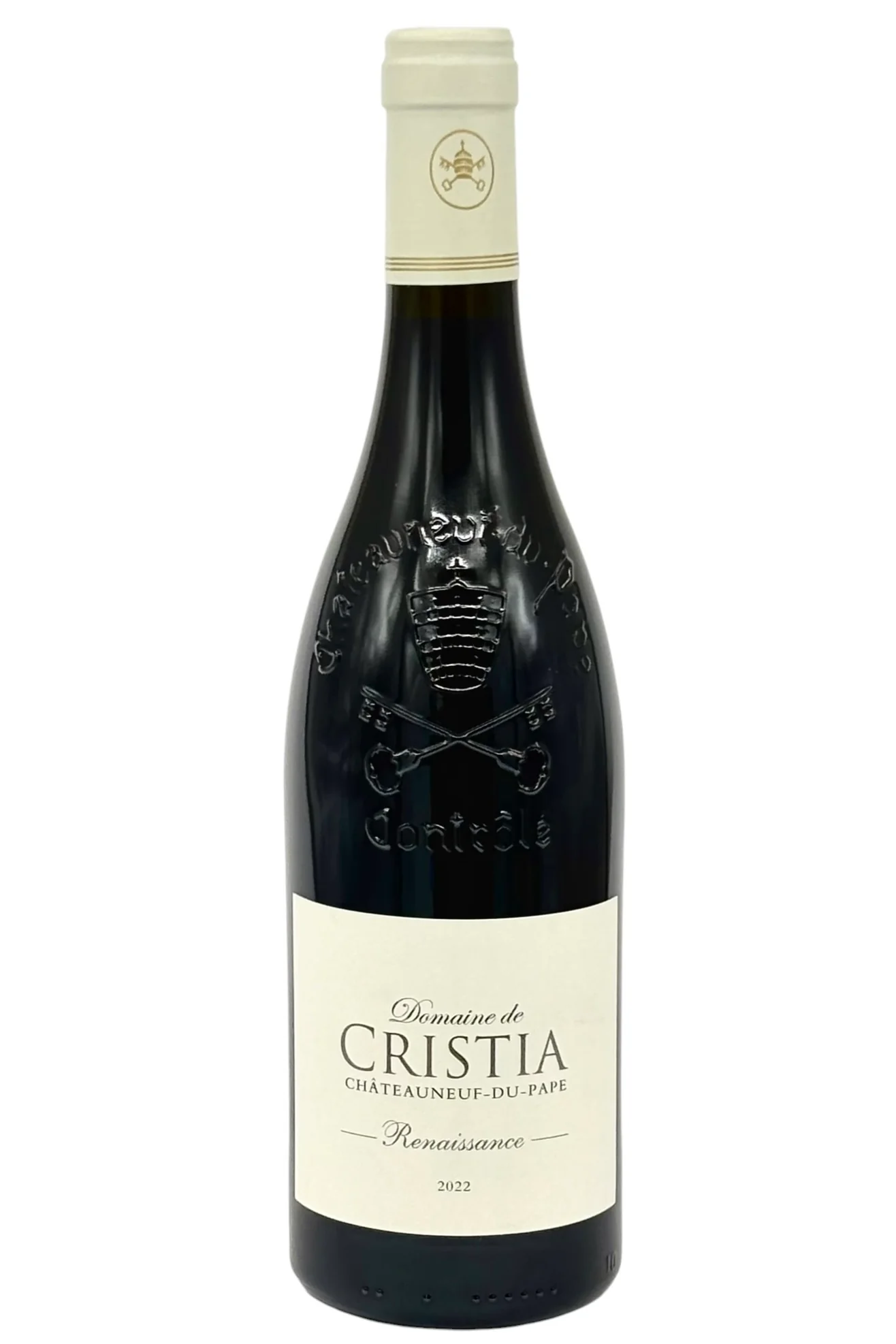
Domaine de Cristia 2022 Chateauneuf-du-Pape Cuvee Renaissance 60% Grenache 40% Mourvedre 114 Year Old Vines Certified Organic 94-96 Points Southern Rhone France 750ml
Domaine de Cristia 2022 Chateauneuf-du-Pape Cuvee Renaissance 60% Grenache 40% Mourvedre 114 Year Old Vines Certified Organic 94-96 Points Southern Rhone France 750ml
Domaine de Cristia's Cuvée Renaissance is the estate's most ambitious and most cellarworthy red — and the 2022 vintage has arrived with critical anticipation bordering on excitement. The Wine Enthusiast awarded the 2016 Renaissance 96 Points, calling it "the most voluptuous of Domaine de Cristia's Châteauneuf-du-Pape bottlings" with blackberry and plum flavors that are "plush and spicy, accented by notes of char, smoke and licorice." The 2022, tasted from barrel, has already earned barrel scores of 94–96 Points from multiple critics — with one reviewer calling the nose "captivating and complex," describing notes of leaf tea, menthol, and pine resin that "show how well some Mourvèdre performed this year."
That Mourvèdre story is the 2022 Renaissance's most compelling production detail. Where most Châteauneuf-du-Pape relies heavily on Grenache's warmth and generous fruit, the Renaissance's 40% Mourvèdre — drawn from 55-year-old vines in the southeast part of the appellation — is the cuvée's structural and aromatic engine. In 2022, a warm, dry growing season that compressed yields and concentrated flavors, the Mourvèdre's naturally dark, tannic, and aromatic character produced exactly the kind of density and complexity that makes this cuvée worthy of its name. Dense and intensely solid, with fine bold tannins, deep-set acidity rising gently through the fruit, and a long finish — this is a wine that will reward patience measured in decades rather than years.
The foundation, however, is the 60% Grenache — drawn from 114-year-old vines in the Cristia Haut lieu-dit. Vines of this age, with root systems extending meters into the ancient sandy clay soils of the northeastern Châteauneuf, produce yields so restricted and fruit so concentrated that no winemaking intervention can improve upon what nature delivers. Baptiste and Dominique Grangeon — the third generation of the family to tend these ancient plants — simply receive what the vines offer and express it with the minimum necessary cellar work. The result is a wine that carries its appellation's identity with complete conviction.
Origins & Craftsmanship
Domaine de Cristia was established in 1942 by Étienne Grangeon — founder of the estate that takes its name from the lieu-dit Le Cristia, a northeastern sector of the Châteauneuf-du-Pape appellation near the village of Courthézon. The estate began with just two hectares of Grenache, with all production sold in bulk to négociants as was standard practice at the time. Étienne's son Alain gradually expanded the vineyard holdings and introduced Syrah and Mourvèdre planting to complement the estate's Grenache base. It was Baptiste Grangeon — Étienne's grandson — who became the first to bottle under the Domaine de Cristia label after inheriting the vineyards in 1999, establishing the estate's independent reputation that has grown steadily to its current standing as one of the appellation's most critically respected producers.
Today Baptiste manages the domaine with his sister Dominique — 20 hectares of vines in Châteauneuf-du-Pape, 90% concentrated in the Cristia lieu-dit with its distinctive sandy clay soils and northeast-facing exposition. That northeastern exposure is the terroir's most defining characteristic: cooler than south-facing Châteauneuf sites, with natural freshness and slower ripening that produces wines of supple, elegant tannins and genuine aromatic complexity rather than simply power and extraction. The estate has been certified organic since the 2008 vintage — a commitment that Baptiste describes as fundamental to expressing the terroir's true character without masking it with chemical inputs.
The Cuvée Renaissance is the estate's prestige red and its most distinctive expression. The 2022 blend draws 60% Grenache from the oldest vines on the estate — specifically from the Cristia Haut lieu-dit, where 114-year-old vines planted in sandy clay soils produce extraordinarily concentrated, low-yield fruit — and 40% Mourvèdre from 55-year-old vines in the southeast part of the appellation, planted in a distinct soil type that gives the Mourvèdre its characteristic density and aromatic complexity. All grapes are destemmed and fermented with indigenous yeasts in concrete vats with a deliberate philosophy of low extraction — allowing the matière to express itself without force. The wine is then aged entirely in wood across three vessel types: two-thirds in demi-muid large format casks, one-third in standard barrique, with one-third of the total in new oak — well-integrated new oak that adds aromatic complexity and structural refinement without overwhelming the fruit. This three-way wood aging program is the most complex and deliberate in the Cristia range and is the direct source of the Renaissance's additional depth and structure relative to the Classic and Vieilles Vignes expressions.
Critics Reviews
"A full-throttle and decadent red, this unfurls layer after layer of spiced fruit cake, plum and cherry liqueur grounded by graphite and smoke notes, plus plum skin bitterness. Ripe tannins melt into the structure of the wine, with seductive notes of simmering incense. For fans of the ultragenerous style, this is stylish and delicious. Drink now through 2038. 250 cases made, 75 cases imported." Wine Spectator 94 Points
Tasting Profile
Nose Captivating and immediately arresting — the 2022 Mourvèdre's influence most apparent from the first pour. Leaf tea and fresh menthol lead the nose with a cool, aromatic intensity that is entirely unlike most Châteauneuf-du-Pape's customary dark fruit opening. Pine resin and crushed herbs add a wild, garrigue-forward dimension before the 114-year-old Grenache's concentrated dark fruit asserts itself: mulled red and black fruits — blackberry, dark plum, and black cherry — deepening alongside roasted garrigue and lavender. Ground pepper and violet add spice and floral elegance, with a whisper of warm vanilla and cedar from the new oak aging completing the aromatic picture. A genuinely complex and layered nose that reveals different dimensions at each approach to the glass.
Palate Dense, intensely solid, and built for the long term — the 2022's compressed tannins and deep-set acidity immediately communicating the wine's structural seriousness. The entry is rich and fruit-forward: dark plum, black cherry, and mulled red fruits arriving in a generous wave before the Mourvèdre's firm, bold tannin structure asserts itself through the mid-palate. Roasted garrigue and ground pepper add savory complexity alongside lavender and a mineral-salty note from the sandy clay terroir. The new oak's contribution is present but well-integrated — vanilla, cedar, and a light toasty quality threading through the fruit without dominating. The 114-year-old vine Grenache's concentration is most apparent in the mid-palate's density and richness — a quality of extract that younger vines cannot produce regardless of yield. The acidity rises gently and persistently through the fruit, providing the freshness and drive that will sustain this wine's development for decades.
Finish Long, structured, and deeply mineral. Fine, bold tannins dry the palate gradually and cleanly alongside a persistent echo of dark fruit, garrigue, and the Mourvèdre's characteristic earthy, slightly mineral depth. The finish extends confidently — the deep-set acidity ensuring it remains fresh and focused rather than heavy at the close. A wine that finishes with the quiet authority of something that knows exactly how good it will be in fifteen years.
Quick Overview
| Category | Details |
|---|---|
| Appellation | Châteauneuf-du-Pape AOC — Southern Rhône Valley, France |
| Vintage | 2022 |
| Producer | Domaine de Cristia — Baptiste & Dominique Grangeon (est. 1942) |
| Cuvée | Renaissance |
| Blend | 60% Grenache Noir (114-year-old vines — Cristia Haut) · 40% Mourvèdre (55-year-old vines — southeast appellation) |
| Soils | Sandy clay — Cristia Haut lieu-dit · Eastern exposure |
| Farming | Certified Organic — since 2008 vintage |
| Fermentation | Destemmed · Indigenous yeasts · Concrete vats · Low extraction |
| Aging | ⅔ demi-muid · ⅓ barrique · ⅓ new oak — fully integrated |
| Vine Age | Grenache: 114 years · Mourvèdre: 55 years |
| Style / Identity | Prestige Châteauneuf-du-Pape — dense, structured, Mourvèdre-driven, cellar-worthy |
| Aromas & Flavors | Leaf tea, menthol, pine resin, dark plum, black cherry, mulled red fruit, roasted garrigue, lavender, ground pepper, violet, vanilla, cedar |
| Drinking Window | 2027–2045+ |
| Critics | 94–96 Points (barrel) · Wine Enthusiast 96 Points (2016 vintage) |
| Bottle Size | 750ml |
Serving & Occasion
Decanting two to three hours is strongly recommended — the 2022's dense, bold tannins and concentrated fruit benefit considerably from extended aeration before the first pour. Serve at 16–18°C in a large Burgundy-style bowl that allows the menthol, garrigue, and dark fruit aromatics to develop fully. The drinking window of 2027–2045+ means those opening a bottle now are experiencing a genuinely young wine with considerable further development ahead — rewarding but not yet at peak complexity. Outstanding alongside roasted rack of lamb, wild game, braised short ribs, duck confit, aged sheep's milk cheese, and any Mediterranean preparation featuring rosemary, lavender, or thyme. An exceptional cellar candidate and serious collector's purchase from one of Châteauneuf-du-Pape's most respected organic producers.
Domaine de Cristia 2022 Chateauneuf-du-Pape Cuvee Renaissance 60% Grenache 40% Mourvedre 114 Year Old Vines Certified Organic 94-96 Points Southern Rhone France 750ml
Domaine de Cristia's Cuvée Renaissance is the estate's most ambitious and most cellarworthy red — and the 2022 vintage has arrived with critical anticipation bordering on excitement. The Wine Enthusiast awarded the 2016 Renaissance 96 Points, calling it "the most voluptuous of Domaine de Cristia's Châteauneuf-du-Pape bottlings" with blackberry and plum flavors that are "plush and spicy, accented by notes of char, smoke and licorice." The 2022, tasted from barrel, has already earned barrel scores of 94–96 Points from multiple critics — with one reviewer calling the nose "captivating and complex," describing notes of leaf tea, menthol, and pine resin that "show how well some Mourvèdre performed this year."
That Mourvèdre story is the 2022 Renaissance's most compelling production detail. Where most Châteauneuf-du-Pape relies heavily on Grenache's warmth and generous fruit, the Renaissance's 40% Mourvèdre — drawn from 55-year-old vines in the southeast part of the appellation — is the cuvée's structural and aromatic engine. In 2022, a warm, dry growing season that compressed yields and concentrated flavors, the Mourvèdre's naturally dark, tannic, and aromatic character produced exactly the kind of density and complexity that makes this cuvée worthy of its name. Dense and intensely solid, with fine bold tannins, deep-set acidity rising gently through the fruit, and a long finish — this is a wine that will reward patience measured in decades rather than years.
The foundation, however, is the 60% Grenache — drawn from 114-year-old vines in the Cristia Haut lieu-dit. Vines of this age, with root systems extending meters into the ancient sandy clay soils of the northeastern Châteauneuf, produce yields so restricted and fruit so concentrated that no winemaking intervention can improve upon what nature delivers. Baptiste and Dominique Grangeon — the third generation of the family to tend these ancient plants — simply receive what the vines offer and express it with the minimum necessary cellar work. The result is a wine that carries its appellation's identity with complete conviction.
Origins & Craftsmanship
Domaine de Cristia was established in 1942 by Étienne Grangeon — founder of the estate that takes its name from the lieu-dit Le Cristia, a northeastern sector of the Châteauneuf-du-Pape appellation near the village of Courthézon. The estate began with just two hectares of Grenache, with all production sold in bulk to négociants as was standard practice at the time. Étienne's son Alain gradually expanded the vineyard holdings and introduced Syrah and Mourvèdre planting to complement the estate's Grenache base. It was Baptiste Grangeon — Étienne's grandson — who became the first to bottle under the Domaine de Cristia label after inheriting the vineyards in 1999, establishing the estate's independent reputation that has grown steadily to its current standing as one of the appellation's most critically respected producers.
Today Baptiste manages the domaine with his sister Dominique — 20 hectares of vines in Châteauneuf-du-Pape, 90% concentrated in the Cristia lieu-dit with its distinctive sandy clay soils and northeast-facing exposition. That northeastern exposure is the terroir's most defining characteristic: cooler than south-facing Châteauneuf sites, with natural freshness and slower ripening that produces wines of supple, elegant tannins and genuine aromatic complexity rather than simply power and extraction. The estate has been certified organic since the 2008 vintage — a commitment that Baptiste describes as fundamental to expressing the terroir's true character without masking it with chemical inputs.
The Cuvée Renaissance is the estate's prestige red and its most distinctive expression. The 2022 blend draws 60% Grenache from the oldest vines on the estate — specifically from the Cristia Haut lieu-dit, where 114-year-old vines planted in sandy clay soils produce extraordinarily concentrated, low-yield fruit — and 40% Mourvèdre from 55-year-old vines in the southeast part of the appellation, planted in a distinct soil type that gives the Mourvèdre its characteristic density and aromatic complexity. All grapes are destemmed and fermented with indigenous yeasts in concrete vats with a deliberate philosophy of low extraction — allowing the matière to express itself without force. The wine is then aged entirely in wood across three vessel types: two-thirds in demi-muid large format casks, one-third in standard barrique, with one-third of the total in new oak — well-integrated new oak that adds aromatic complexity and structural refinement without overwhelming the fruit. This three-way wood aging program is the most complex and deliberate in the Cristia range and is the direct source of the Renaissance's additional depth and structure relative to the Classic and Vieilles Vignes expressions.
Critics Reviews
"A full-throttle and decadent red, this unfurls layer after layer of spiced fruit cake, plum and cherry liqueur grounded by graphite and smoke notes, plus plum skin bitterness. Ripe tannins melt into the structure of the wine, with seductive notes of simmering incense. For fans of the ultragenerous style, this is stylish and delicious. Drink now through 2038. 250 cases made, 75 cases imported." Wine Spectator 94 Points
Tasting Profile
Nose Captivating and immediately arresting — the 2022 Mourvèdre's influence most apparent from the first pour. Leaf tea and fresh menthol lead the nose with a cool, aromatic intensity that is entirely unlike most Châteauneuf-du-Pape's customary dark fruit opening. Pine resin and crushed herbs add a wild, garrigue-forward dimension before the 114-year-old Grenache's concentrated dark fruit asserts itself: mulled red and black fruits — blackberry, dark plum, and black cherry — deepening alongside roasted garrigue and lavender. Ground pepper and violet add spice and floral elegance, with a whisper of warm vanilla and cedar from the new oak aging completing the aromatic picture. A genuinely complex and layered nose that reveals different dimensions at each approach to the glass.
Palate Dense, intensely solid, and built for the long term — the 2022's compressed tannins and deep-set acidity immediately communicating the wine's structural seriousness. The entry is rich and fruit-forward: dark plum, black cherry, and mulled red fruits arriving in a generous wave before the Mourvèdre's firm, bold tannin structure asserts itself through the mid-palate. Roasted garrigue and ground pepper add savory complexity alongside lavender and a mineral-salty note from the sandy clay terroir. The new oak's contribution is present but well-integrated — vanilla, cedar, and a light toasty quality threading through the fruit without dominating. The 114-year-old vine Grenache's concentration is most apparent in the mid-palate's density and richness — a quality of extract that younger vines cannot produce regardless of yield. The acidity rises gently and persistently through the fruit, providing the freshness and drive that will sustain this wine's development for decades.
Finish Long, structured, and deeply mineral. Fine, bold tannins dry the palate gradually and cleanly alongside a persistent echo of dark fruit, garrigue, and the Mourvèdre's characteristic earthy, slightly mineral depth. The finish extends confidently — the deep-set acidity ensuring it remains fresh and focused rather than heavy at the close. A wine that finishes with the quiet authority of something that knows exactly how good it will be in fifteen years.
Quick Overview
| Category | Details |
|---|---|
| Appellation | Châteauneuf-du-Pape AOC — Southern Rhône Valley, France |
| Vintage | 2022 |
| Producer | Domaine de Cristia — Baptiste & Dominique Grangeon (est. 1942) |
| Cuvée | Renaissance |
| Blend | 60% Grenache Noir (114-year-old vines — Cristia Haut) · 40% Mourvèdre (55-year-old vines — southeast appellation) |
| Soils | Sandy clay — Cristia Haut lieu-dit · Eastern exposure |
| Farming | Certified Organic — since 2008 vintage |
| Fermentation | Destemmed · Indigenous yeasts · Concrete vats · Low extraction |
| Aging | ⅔ demi-muid · ⅓ barrique · ⅓ new oak — fully integrated |
| Vine Age | Grenache: 114 years · Mourvèdre: 55 years |
| Style / Identity | Prestige Châteauneuf-du-Pape — dense, structured, Mourvèdre-driven, cellar-worthy |
| Aromas & Flavors | Leaf tea, menthol, pine resin, dark plum, black cherry, mulled red fruit, roasted garrigue, lavender, ground pepper, violet, vanilla, cedar |
| Drinking Window | 2027–2045+ |
| Critics | 94–96 Points (barrel) · Wine Enthusiast 96 Points (2016 vintage) |
| Bottle Size | 750ml |
Serving & Occasion
Decanting two to three hours is strongly recommended — the 2022's dense, bold tannins and concentrated fruit benefit considerably from extended aeration before the first pour. Serve at 16–18°C in a large Burgundy-style bowl that allows the menthol, garrigue, and dark fruit aromatics to develop fully. The drinking window of 2027–2045+ means those opening a bottle now are experiencing a genuinely young wine with considerable further development ahead — rewarding but not yet at peak complexity. Outstanding alongside roasted rack of lamb, wild game, braised short ribs, duck confit, aged sheep's milk cheese, and any Mediterranean preparation featuring rosemary, lavender, or thyme. An exceptional cellar candidate and serious collector's purchase from one of Châteauneuf-du-Pape's most respected organic producers.
Product Information
Product Information
Shipping & Returns
Shipping & Returns
Description
Domaine de Cristia's Cuvée Renaissance is the estate's most ambitious and most cellarworthy red — and the 2022 vintage has arrived with critical anticipation bordering on excitement. The Wine Enthusiast awarded the 2016 Renaissance 96 Points, calling it "the most voluptuous of Domaine de Cristia's Châteauneuf-du-Pape bottlings" with blackberry and plum flavors that are "plush and spicy, accented by notes of char, smoke and licorice." The 2022, tasted from barrel, has already earned barrel scores of 94–96 Points from multiple critics — with one reviewer calling the nose "captivating and complex," describing notes of leaf tea, menthol, and pine resin that "show how well some Mourvèdre performed this year."
That Mourvèdre story is the 2022 Renaissance's most compelling production detail. Where most Châteauneuf-du-Pape relies heavily on Grenache's warmth and generous fruit, the Renaissance's 40% Mourvèdre — drawn from 55-year-old vines in the southeast part of the appellation — is the cuvée's structural and aromatic engine. In 2022, a warm, dry growing season that compressed yields and concentrated flavors, the Mourvèdre's naturally dark, tannic, and aromatic character produced exactly the kind of density and complexity that makes this cuvée worthy of its name. Dense and intensely solid, with fine bold tannins, deep-set acidity rising gently through the fruit, and a long finish — this is a wine that will reward patience measured in decades rather than years.
The foundation, however, is the 60% Grenache — drawn from 114-year-old vines in the Cristia Haut lieu-dit. Vines of this age, with root systems extending meters into the ancient sandy clay soils of the northeastern Châteauneuf, produce yields so restricted and fruit so concentrated that no winemaking intervention can improve upon what nature delivers. Baptiste and Dominique Grangeon — the third generation of the family to tend these ancient plants — simply receive what the vines offer and express it with the minimum necessary cellar work. The result is a wine that carries its appellation's identity with complete conviction.
Origins & Craftsmanship
Domaine de Cristia was established in 1942 by Étienne Grangeon — founder of the estate that takes its name from the lieu-dit Le Cristia, a northeastern sector of the Châteauneuf-du-Pape appellation near the village of Courthézon. The estate began with just two hectares of Grenache, with all production sold in bulk to négociants as was standard practice at the time. Étienne's son Alain gradually expanded the vineyard holdings and introduced Syrah and Mourvèdre planting to complement the estate's Grenache base. It was Baptiste Grangeon — Étienne's grandson — who became the first to bottle under the Domaine de Cristia label after inheriting the vineyards in 1999, establishing the estate's independent reputation that has grown steadily to its current standing as one of the appellation's most critically respected producers.
Today Baptiste manages the domaine with his sister Dominique — 20 hectares of vines in Châteauneuf-du-Pape, 90% concentrated in the Cristia lieu-dit with its distinctive sandy clay soils and northeast-facing exposition. That northeastern exposure is the terroir's most defining characteristic: cooler than south-facing Châteauneuf sites, with natural freshness and slower ripening that produces wines of supple, elegant tannins and genuine aromatic complexity rather than simply power and extraction. The estate has been certified organic since the 2008 vintage — a commitment that Baptiste describes as fundamental to expressing the terroir's true character without masking it with chemical inputs.
The Cuvée Renaissance is the estate's prestige red and its most distinctive expression. The 2022 blend draws 60% Grenache from the oldest vines on the estate — specifically from the Cristia Haut lieu-dit, where 114-year-old vines planted in sandy clay soils produce extraordinarily concentrated, low-yield fruit — and 40% Mourvèdre from 55-year-old vines in the southeast part of the appellation, planted in a distinct soil type that gives the Mourvèdre its characteristic density and aromatic complexity. All grapes are destemmed and fermented with indigenous yeasts in concrete vats with a deliberate philosophy of low extraction — allowing the matière to express itself without force. The wine is then aged entirely in wood across three vessel types: two-thirds in demi-muid large format casks, one-third in standard barrique, with one-third of the total in new oak — well-integrated new oak that adds aromatic complexity and structural refinement without overwhelming the fruit. This three-way wood aging program is the most complex and deliberate in the Cristia range and is the direct source of the Renaissance's additional depth and structure relative to the Classic and Vieilles Vignes expressions.
Critics Reviews
"A full-throttle and decadent red, this unfurls layer after layer of spiced fruit cake, plum and cherry liqueur grounded by graphite and smoke notes, plus plum skin bitterness. Ripe tannins melt into the structure of the wine, with seductive notes of simmering incense. For fans of the ultragenerous style, this is stylish and delicious. Drink now through 2038. 250 cases made, 75 cases imported." Wine Spectator 94 Points
Tasting Profile
Nose Captivating and immediately arresting — the 2022 Mourvèdre's influence most apparent from the first pour. Leaf tea and fresh menthol lead the nose with a cool, aromatic intensity that is entirely unlike most Châteauneuf-du-Pape's customary dark fruit opening. Pine resin and crushed herbs add a wild, garrigue-forward dimension before the 114-year-old Grenache's concentrated dark fruit asserts itself: mulled red and black fruits — blackberry, dark plum, and black cherry — deepening alongside roasted garrigue and lavender. Ground pepper and violet add spice and floral elegance, with a whisper of warm vanilla and cedar from the new oak aging completing the aromatic picture. A genuinely complex and layered nose that reveals different dimensions at each approach to the glass.
Palate Dense, intensely solid, and built for the long term — the 2022's compressed tannins and deep-set acidity immediately communicating the wine's structural seriousness. The entry is rich and fruit-forward: dark plum, black cherry, and mulled red fruits arriving in a generous wave before the Mourvèdre's firm, bold tannin structure asserts itself through the mid-palate. Roasted garrigue and ground pepper add savory complexity alongside lavender and a mineral-salty note from the sandy clay terroir. The new oak's contribution is present but well-integrated — vanilla, cedar, and a light toasty quality threading through the fruit without dominating. The 114-year-old vine Grenache's concentration is most apparent in the mid-palate's density and richness — a quality of extract that younger vines cannot produce regardless of yield. The acidity rises gently and persistently through the fruit, providing the freshness and drive that will sustain this wine's development for decades.
Finish Long, structured, and deeply mineral. Fine, bold tannins dry the palate gradually and cleanly alongside a persistent echo of dark fruit, garrigue, and the Mourvèdre's characteristic earthy, slightly mineral depth. The finish extends confidently — the deep-set acidity ensuring it remains fresh and focused rather than heavy at the close. A wine that finishes with the quiet authority of something that knows exactly how good it will be in fifteen years.
Quick Overview
| Category | Details |
|---|---|
| Appellation | Châteauneuf-du-Pape AOC — Southern Rhône Valley, France |
| Vintage | 2022 |
| Producer | Domaine de Cristia — Baptiste & Dominique Grangeon (est. 1942) |
| Cuvée | Renaissance |
| Blend | 60% Grenache Noir (114-year-old vines — Cristia Haut) · 40% Mourvèdre (55-year-old vines — southeast appellation) |
| Soils | Sandy clay — Cristia Haut lieu-dit · Eastern exposure |
| Farming | Certified Organic — since 2008 vintage |
| Fermentation | Destemmed · Indigenous yeasts · Concrete vats · Low extraction |
| Aging | ⅔ demi-muid · ⅓ barrique · ⅓ new oak — fully integrated |
| Vine Age | Grenache: 114 years · Mourvèdre: 55 years |
| Style / Identity | Prestige Châteauneuf-du-Pape — dense, structured, Mourvèdre-driven, cellar-worthy |
| Aromas & Flavors | Leaf tea, menthol, pine resin, dark plum, black cherry, mulled red fruit, roasted garrigue, lavender, ground pepper, violet, vanilla, cedar |
| Drinking Window | 2027–2045+ |
| Critics | 94–96 Points (barrel) · Wine Enthusiast 96 Points (2016 vintage) |
| Bottle Size | 750ml |
Serving & Occasion
Decanting two to three hours is strongly recommended — the 2022's dense, bold tannins and concentrated fruit benefit considerably from extended aeration before the first pour. Serve at 16–18°C in a large Burgundy-style bowl that allows the menthol, garrigue, and dark fruit aromatics to develop fully. The drinking window of 2027–2045+ means those opening a bottle now are experiencing a genuinely young wine with considerable further development ahead — rewarding but not yet at peak complexity. Outstanding alongside roasted rack of lamb, wild game, braised short ribs, duck confit, aged sheep's milk cheese, and any Mediterranean preparation featuring rosemary, lavender, or thyme. An exceptional cellar candidate and serious collector's purchase from one of Châteauneuf-du-Pape's most respected organic producers.